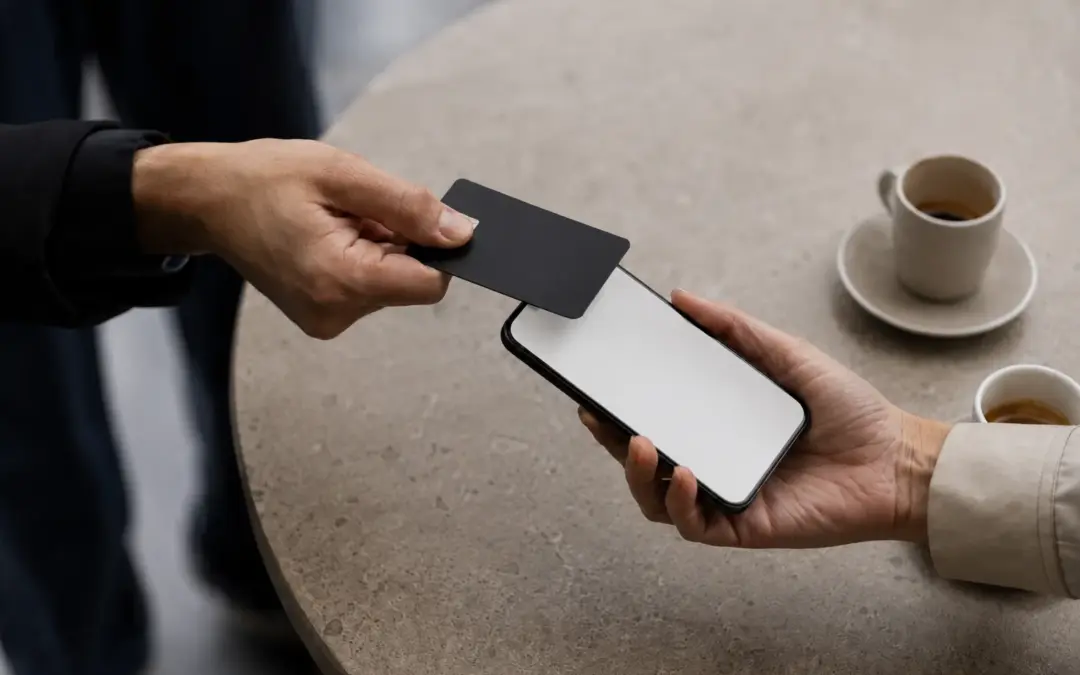
It’s the most common question from anyone modernizing company cards: NFC or QR code? The honest answer is that they’re not rivals — they’re tools for different moments. But if you’re about to print a thousand cards, it pays to choose deliberately.
What the two have in common
Both solve paper’s essential problem: they connect a physical object to a page that stays up to date. Both work without an installed app. And both end up in the same place — your contact page, with the vCard one tap away.
Where NFC wins
The gesture. Tapping is faster and more natural than aiming a camera: it needs no light, no steady hand, no hunting for the little square on the back of the card. At a noisy fair, drink in one hand, the difference between “tap here” and “point the camera, wait, click the link” is the difference between a saved contact and a maybe.
Perception. An NFC card in premium plastic signals investment. A printed QR signals restaurant poster. Unfair? Perhaps — but the business card has always been an object of perception.
The object’s durability. The chip doesn’t fade, doesn’t crease and doesn’t stop working with wallet wear. A scratched or folded QR stops scanning.
Where the QR code wins
At a distance and at scale. A QR works on a slide, a roll-up, a booth screen, an email. NFC requires physical proximity — that is its nature. For a stage or a shop window, QR is unbeatable.
Zero marginal cost. Printing one more QR costs nothing. For mass campaign disposables (flyers, giveaways), it makes sense.
The practical answer
Use both where each is strong: NFC on the personal and team card — the handshake moment — and QR on at-a-distance materials. Our pages serve both at once: the same link lives in the chip and in a QR, and the per-card and per-campaign statistics tell you which of the two is working harder in each context.
While you’re here: we explained how an NFC card works on the inside — no magic, just physics.